
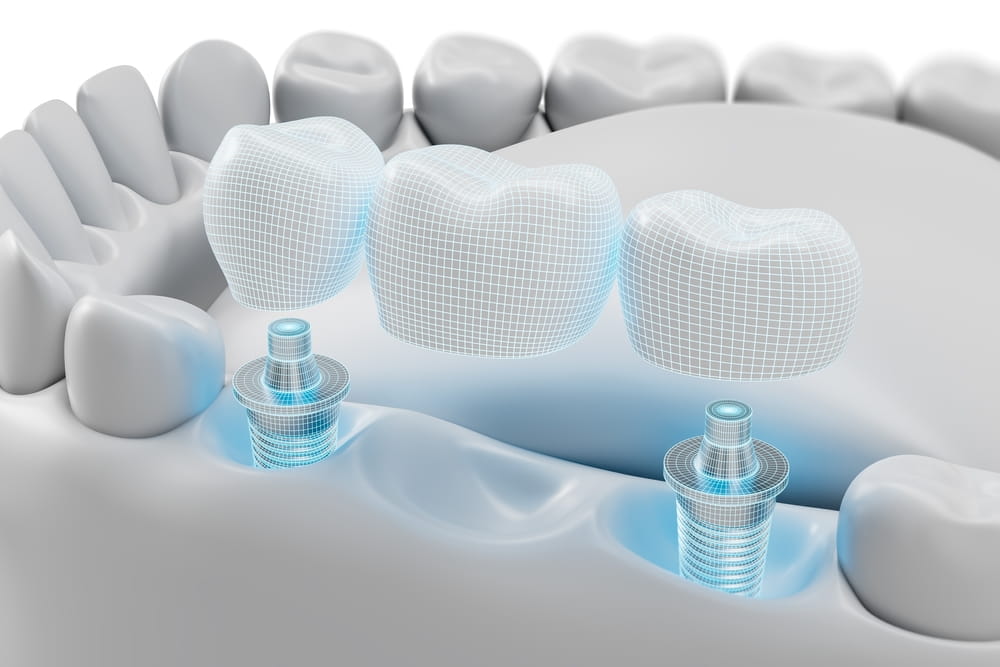
Patients at Wyngate Dental of Bethesda in Bethesda, MD often ask whether dental implants or dental bridges are the better long-term solution for replacing missing teeth. Both options are effective and widely used in restorative dentistry, but they differ in structure, longevity, and impact on surrounding teeth. Understanding these differences can help you choose the option that best supports your oral health for years to come.
Understanding Dental Bridges
How Dental Bridges Work
A dental bridge replaces one or more missing teeth by anchoring an artificial tooth (or teeth) to the natural teeth on either side of the gap. These supporting teeth are typically prepared and fitted with crowns to hold the bridge securely in place. Bridges restore function and appearance, allowing patients to chew, speak, and smile with confidence.
Traditional bridges are commonly recommended when the surrounding teeth already require support from crowns or have large restorations. In these cases, preparing adjacent teeth for crowns may align naturally with the overall treatment plan. Bridges can be crafted from durable materials designed to blend seamlessly with natural teeth.
Long-Term Considerations
While bridges are effective, they rely heavily on the strength and health of neighboring teeth. Preparing adjacent teeth requires removing some natural enamel, which may increase vulnerability over time. If one of the supporting teeth develops decay or structural problems, the entire bridge may need replacement.
On average, dental bridges last between 10 and 15 years with proper care. Excellent oral hygiene, routine exams, and professional cleanings are essential to protect both the bridge and supporting teeth. In some cases, additional treatments such as crowns and bridges may be needed later to maintain stability.
Exploring Dental Implants
How Dental Implants Work
Dental implants replace missing teeth by inserting a small titanium post into the jawbone, where it functions as an artificial tooth root. Over time, the implant integrates with the bone through a process called osseointegration. Once healed, a custom crown is attached to the implant to complete the restoration.
Unlike bridges, implants do not depend on neighboring teeth for support. They stand independently, preserving the integrity of surrounding natural teeth. Implant dentistry has become one of the most reliable and predictable methods for long-term tooth replacement.
Long-Term Advantages
One of the most significant benefits of dental implants is their durability. With proper care, implants can last decades and, in many cases, a lifetime. Because they replace the tooth root, implants also help maintain jawbone density and prevent bone loss that naturally occurs after tooth extraction.
Implants are especially beneficial for patients who want a solution that closely mimics natural teeth in both appearance and function. Options such as single tooth implants or even full arch implants provide flexibility depending on the number of missing teeth. Additionally, because implants integrate with the bone, they offer stability that supports normal chewing without shifting or slipping.
Comparing Longevity and Oral Health Impact
When evaluating which option is best long term, several factors should be considered:
- Preservation of surrounding natural teeth
- Impact on jawbone health
- Expected lifespan of the restoration
- Maintenance requirements
- Overall cost over time
Bridges may involve a lower initial investment and shorter treatment timeline. However, they do not prevent bone loss in the area of the missing tooth. Implants, while requiring a surgical procedure and longer healing period, provide structural support that protects both bone and adjacent teeth.
In some cases, patients may also require related procedures such as extractions or socket preservation before implant placement to ensure optimal outcomes. A comprehensive evaluation helps determine whether bone quality and overall health support implant candidacy.
Choosing the Right Long-Term Solution
The decision between dental implants and bridges depends on individual health, preferences, and long-term goals. Patients seeking maximum durability and bone preservation often lean toward implants, while those looking for a non-surgical option may consider bridges. Factors such as gum health, which may require periodontal maintenance, also influence treatment planning.
For individuals in Bethesda, MD exploring tooth replacement options, understanding the long-term implications of each treatment is essential. At Wyngate Dental of Bethesda, patients can learn about dental implants, bridges, and other restorative options designed to support lasting oral health. By weighing the benefits of stability, longevity, and preservation, you can select a solution that protects your smile well into the future.
Sources
American College of Prosthodontists. (2022). Dental Implants vs. Bridges: Understanding Tooth Replacement Options. ACP.org.
Misch, C. E. (2008). Contemporary Implant Dentistry. Mosby Elsevier.
Pjetursson, B. E., Tan, K., Lang, N. P., Brägger, U., Egger, M., & Zwahlen, M. (2004). A systematic review of the survival and complication rates of fixed partial dentures and implant-supported single crowns. Clinical Oral Implants Research.